
Data Centres Are Not Outside the Tariff Dispute
What Canadian Data Centre Developers Need to Know
By Paula McGarrigle, President & CEO, Solas Energy
Data centres are usually discussed in terms of computing capacity, electricity demand and, increasingly, artificial intelligence. They are less often discussed as very large construction and electrical projects.
That distinction matters under Canada’s new countertariffs against the United States.
The principal server classifications do not appear in the current list effective September 8, 2026. Neither do conventional UPS batteries, static converters, large transformers or primary switchgear. It would be easy enough to conclude that data centres are outside the tariff dispute.
They are not. The building, cooling, networking and grid infrastructure surrounding the servers can contain a considerable amount of tariff-exposed US equipment.
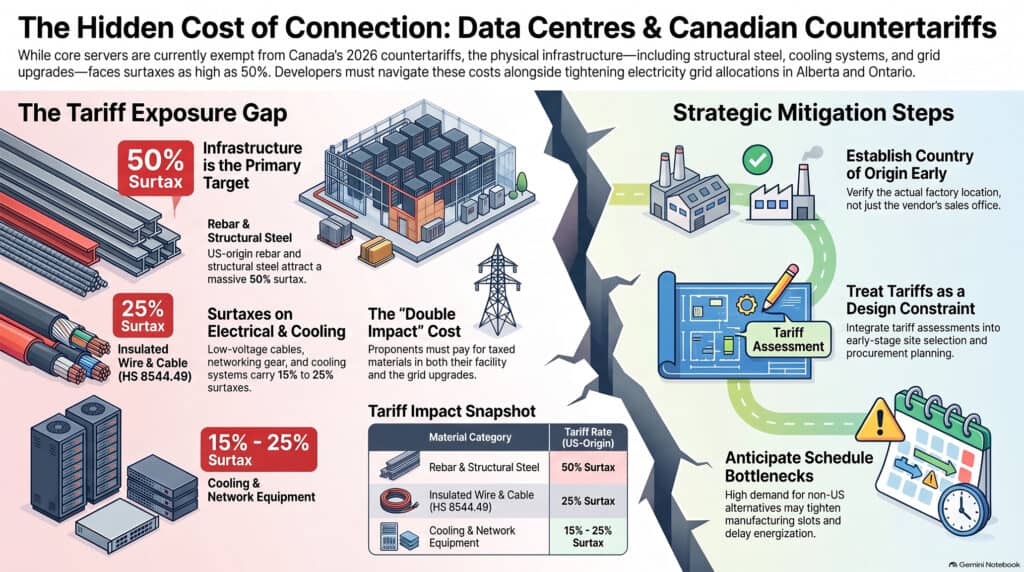
The exposure is in the infrastructure
A data centre requires far more than server racks. It needs a heavily reinforced building, electrical rooms, network equipment, cooling systems, backup power, transformers, switchgear, substations and, in many cases, new transmission or generation infrastructure.
US-origin rebar and structural steel can attract a 50 percent surtax. So can certain aluminum products and network switching and routing apparatus under HS 8517.62. Low-voltage insulated wire and cable under HS 8544.49 are subject to 25 percent, while certain monitors and printed circuit assemblies are also included.
Some fans, compressors and air-conditioning products carry rates of 15 or 25 percent, depending on their precise classification. The classification of specialized data-centre chillers and integrated cooling systems should be checked rather than inferred from a general description.
The current government webpage also contains historical tariff tables. Certain automatic data-processing products under HS 8471 appear in an older section, but not in the current September 8 list. Procurement teams need to make sure they are reading the correct effective period.
Alberta has an immediate connection challenge
Alberta has seen extraordinary interest from data-centre developers. The AESO initially reported 29 proposed projects representing more than 16 GW of demand seeking grid connections. It established an interim limit allowing up to 1,200 MW of large-load projects to connect by 2028.
That allocation is now fully taken. The AESO reports executed load contracts for the 970 MW GLDC Load project and the 230 MW first phase of the Keephills Data Centre. Both are proceeding through the connection process, while other proposed large loads move into the next stage of the AESO’s integration programme.
This is not merely a question of whether a data centre can source servers. It is whether the grid can supply the load and who will pay for the generation, transmission, substations and storage required to serve it.
Ontario is seeing the same demand emerge
The IESO’s 2026 Annual Planning Outlook identifies growing interest in large, electricity-intensive data centres. Several projects have active System Impact Assessments or began construction in 2024.
Ontario is also procuring new renewable generation and battery storage. In 2026, the IESO executed contracts for 13 renewable projects totalling 1,115.1 MW and three battery projects totalling 640 MW. Data-centre growth and new electricity procurement are not separate stories. Each new large load adds pressure to deliver generation and grid infrastructure on time.
Data centres may have to carry the infrastructure cost
The Government of Canada’s Responsible Data Centre Development Principles state that data centres should not shift their electricity costs to households and existing businesses. Proponents are expected to pay the costs of connecting and serving their projects, including project-driven generation, transmission, substations and grid upgrades. They may also need to contribute storage or demand flexibility.
That policy position places tariff exposure squarely in the data-centre business case. If the connection requires a new substation, BESS facility, transmission reinforcement or generation project, the cost of tariffed steel, rebar, cable and controls may ultimately sit with the data-centre proponent.
A development may therefore be affected twice: first through construction of the facility itself, and again through the electricity infrastructure required to energize it.
Origin needs to be established before ordering
The relevant test is country of origin, not the location of the vendor’s sales office. A US technology company may supply equipment produced in Mexico, Taiwan or Europe. A Canadian or European supplier may allocate the order to a US plant.
For each major package, the procurement file should identify the actual factory, proposed HS classification and origin of the delivered product. For structural materials, mill certificates and heat numbers should be traceable to the shipment. For integrated electrical or cooling packages, the supplier should explain whether the complete unit or its separate components will be declared at the border.
CBSA does not require a special CUSMA form. A commercial invoice or another document may be used if it contains the prescribed minimum data elements. The importer must nevertheless retain the evidence supporting the declaration and may be examined at import or through a post-release verification.
A budget and schedule issue
Data centres are not prohibited by the new measures, and their core computing equipment is not the main target. Even so, a 50 percent charge on US-origin rebar, structural steel or network equipment can be material on a large campus.
The greater risk may be schedule. If every major project begins looking for the same Canadian steel, cable and electrical alternatives, manufacturing slots can tighten. A technically available substitute is not much help if it arrives after the planned energization date.
Developers should treat tariffs as an early design and procurement issue, alongside power availability, cooling, water, interconnection and permitting. It is one more reason to understand the full infrastructure requirement before committing to a site or operating date.
Official references
- Government of Canada complete countertariff list
- CBSA Customs Notice 26-23
- Canada Responsible Data Centre Development Principles
- AESO large-load projects
- AESO interim large-load approach
- IESO 2026 Annual Planning Outlook demand module
- IESO Long-Term 2 procurement
Editorial note
The tariff analysis is a project-screening assessment based on official measures in force or announced as of September 9, 2026. Customs classification and origin are fact-specific. Importers should obtain advice from a Canadian customs broker or request a CBSA advance ruling where the treatment is material or uncertain.