
Hydrogen Projects Face Tariff Exposure Beyond the Electrolyser
The Steel Piping Storage and Electrical Systems May Carry the Greater Risk
By Paula McGarrigle, President & CEO, Solas Energy
The first question asked about a green-hydrogen project is usually the cost of the electrolyser. Under Canada’s new countertariffs, that may not be the most useful place to begin.
The principal electrolyser package is not the clearest exposure in the list effective September 8, 2026. The plant surrounding it is another matter. A commercial hydrogen or ammonia facility needs steel structures, rebar, pipe, fittings, compressors, pressure vessels, storage tanks, cooling equipment, rectifiers, controls, substations and export infrastructure.
A project can therefore avoid a direct surtax on its headline technology and still carry a substantial tariff cost in the balance of plant.
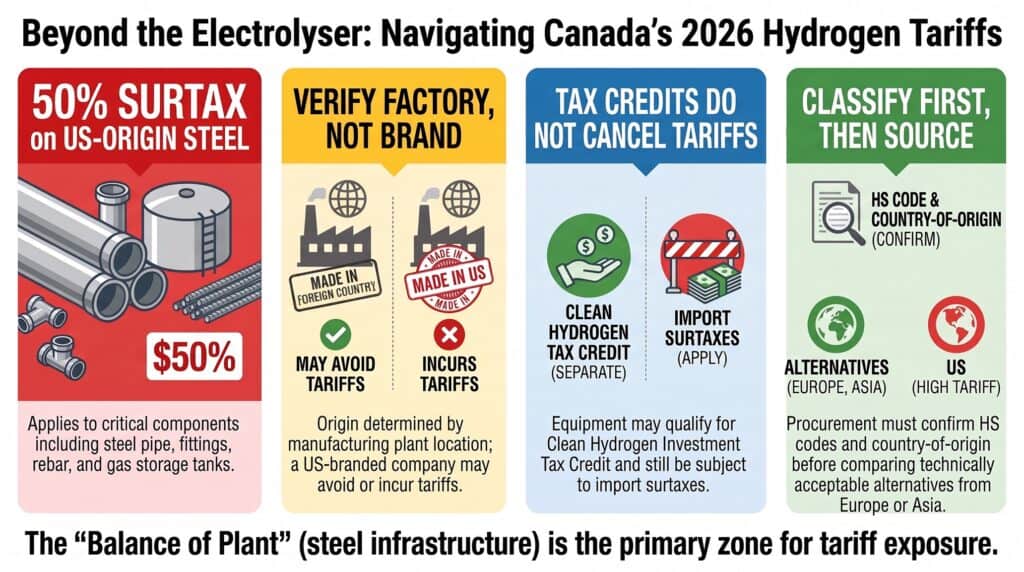
The exposure is spread through the plant
Designated US-origin steel pipe and pipe fittings generally carry a 50 percent Canadian surtax. Containers for compressed or liquefied gas under HS 7311 are listed at 50 percent, as are many steel tanks and fabricated structures. Certain compressors, fans, wire, cable and control products are subject to rates of 15 or 25 percent, depending on their precise classification.
US-origin rebar can attract 50 percent. That reaches process buildings, equipment foundations, storage areas, pipe racks, marine terminals and the concrete works associated with substations and water treatment.
Valves, instrumentation and many heat-exchange or process-equipment classifications are not directly identified in the current list, but that should not be mistaken for a blanket exemption. Every imported package must be classified as presented at the border. A rectifier shipped with an electrolyser may receive a different treatment from one imported separately.
Origin is a factory question
The name on the equipment is not enough. A US technology company may manufacture in Europe or Asia. A European supplier may allocate a Canadian order to a US plant. A Canadian fabricator may incorporate US steel into a finished product whose origin requires a separate analysis.
Procurement teams should obtain the actual manufacturing plant, proposed HS classification, country of origin and separate values for the main equipment, steel, cable, controls and ancillary systems. Steel mill certificates, heat numbers and fabrication records should be retained where they support the origin declaration.
CBSA does not require a special CUSMA certificate form. The required data may be provided on an invoice or another document, but the importer remains responsible for the declaration and the supporting evidence. CBSA may review the goods at import or conduct a later verification.
A substitute must still be bankable and certifiable
Canadian steel, pipe, tanks, structural fabrication and rebar are the most direct alternatives where domestic capacity, specifications and delivery dates align. Europe offers mature electrolyser and process-equipment supply and benefits from the CETA framework. Qualified Asian supply may also be available.
None of those alternatives is automatic. Substitution can affect the pressure design, hazardous-area classification, electrical listing, control integration, warranty, performance guarantee, lender review and spare-parts strategy. A cheaper customs result is no bargain if the change triggers redesign or delays commissioning.
The practical sequence is to classify first, confirm origin second and then compare technically acceptable alternatives on delivered cost and schedule.
The tax credit makes equipment definition important
Canada’s Clean Hydrogen Investment Tax Credit applies to eligible property acquired and available for use within the legislated period. The programme requires a clean-hydrogen project plan and supporting technical and carbon-intensity information.
Tariff classification and tax-credit eligibility are separate tests. Equipment may qualify for an investment tax credit and still attract a surtax when imported. Conversely, an untariffed item may sit outside the eligible-property rules. Financial models should not net one assumption against the other without checking both regimes.
The federal technical and equipment guidance is therefore part of procurement, not merely tax administration. The equipment list, project boundary and carbon-intensity model should reconcile with what will actually be purchased and imported.
Nova Scotia has time to design around the risk
Nova Scotia’s Green Hydrogen Action Plan contemplates domestic use and exports of hydrogen and its derivatives. The sector remains at an early stage, and not every announced project will reach construction. That uncertainty makes disciplined procurement more important, not less.
For export-scale hydrogen or ammonia, the tariff exposure may sit more heavily in piping, storage, compression, civil works and marine facilities than in the electrolyser stack. Export terminals add tanks, loading systems, pipe racks, buildings and port works, all of which widen the origin analysis.
Project agreements should require country-of-origin schedules, named factories, alternative sourcing plans and a clear allocation of tariff and change-in-law risk. They should also address what happens if a supplier changes its manufacturing location after contract award.
Hydrogen exports need a second border analysis
A Canadian plant’s equipment is assessed when it enters Canada. Hydrogen, ammonia and related products exported later face their own classification, transport and market-access rules in the destination country. Infrastructure installed at a US receiving terminal is assessed under US measures, not the Canadian countertariff list.
A supply chain designed around Canadian construction rules may therefore produce a different result at the export terminal. The destination market, carrier, storage configuration and long-term offtake plan should be considered before the project fixes its equipment and logistics strategy. The tariffs are another design constraint: addressed while specifications and contracts remain open, they can be managed; left until shipment, they will be costly and awkward.
Official references
- Government of Canada complete countertariff list
- CBSA Customs Notice 26-23
- Nova Scotia Green Hydrogen Action Plan
- Government of Nova Scotia green hydrogen programme
- Hydrogen Strategy for Canada progress report
- Canada Clean Hydrogen Investment Tax Credit
- Clean Hydrogen Investment Tax Credit technical and equipment guidance
Editorial note
The tariff analysis is a project-screening assessment based on official measures in force or announced as of September 9, 2026. Customs classification and origin are fact-specific. Importers should obtain advice from a Canadian customs broker or request a CBSA advance ruling where the treatment is material or uncertain.