
Nova Scotia Offshore Wind Supply Chains Under Canada US Tariffs
Why Early Procurement Decisions Matter Before the First Call for Bids
By Paula McGarrigle, President & CEO, Solas Energy
Nova Scotia is not the province most immediately exposed to Canada’s new countertariffs. Its offshore wind industry has not yet reached large-scale equipment procurement. That is precisely why the issue deserves attention now.
The Canada–Nova Scotia Offshore Energy Regulator has completed prequalification for the province’s first offshore wind call for bids. Four broad Wind Energy Areas have been designated, and the formal call is expected to follow. Federal–provincial strategic direction initially contemplated licences for up to 3,000 MW across three areas, while the province’s broader near-term ambition is 5,000 MW.
These are not yet power purchase agreements or turbine orders. Routes to market, transmission, offtake and final project configurations remain under development. In the present trade environment, that unsettled position can be useful. Nova Scotia still has time to ask where the equipment will actually be made and who will carry the tariff risk.
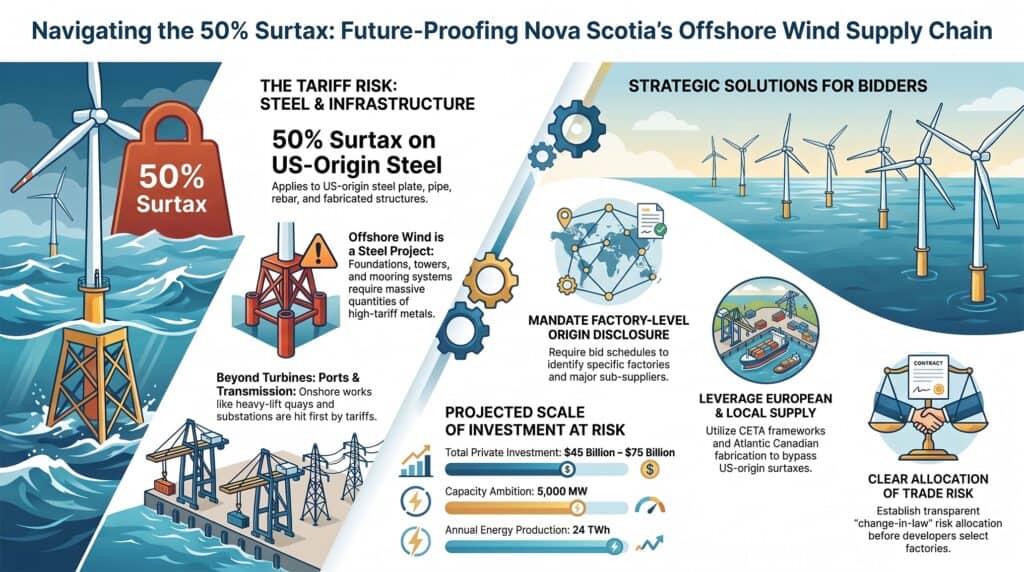
Offshore wind is a steel project as well as an energy project
Offshore wind is more exposed to metals policy than onshore wind. Monopiles, jackets, floating platforms, towers, transition pieces, access structures, anchors and mooring systems all require substantial quantities of steel.
Under Canada’s measures effective September 8, 2026, designated US-origin steel plate, pipe, fittings, fabricated structures, chains, anchors and fasteners can attract a 50 percent surtax. US-origin rebar used in port reconstruction, heavy-lift quays, storage areas, converter stations and other onshore works can face the same rate.
A complete wind-powered generating set is not itself a principal item on the current list. That does not settle the treatment of a foundation, tower or other component imported separately. The commercial description on a purchase order is not the customs classification.
Ports and transmission may feel the effect first
Nova Scotia’s Wind West plan places major construction in the 2031 to 2033 period, with studies, design and preconstruction beforehand. Turbine procurement may still be several years away, but port and transmission decisions will come sooner.
Offshore assembly requires strengthened quays, heavy-lift capability, storage areas and transport routes. Delivering the power requires offshore substations, array cable, export cable, onshore substations and potentially HVDC converter facilities.
Large transformers and primary switchgear are generally outside the current Canadian list. Structural steel, aluminium, rebar, low-voltage control cable and some communications equipment may not be. High-voltage submarine cable requires its own classification analysis; it should not be treated as ordinary low-voltage cable merely because both are called cable.
A European supplier is not automatically a European origin
Europe offers a mature offshore wind supply chain and, through CETA, an established trade framework with Canada. It is an obvious place to look for alternatives to US supply. But a supplier’s headquarters do not establish the origin of the delivered equipment.
A European turbine manufacturer may allocate blades, nacelles, towers or electrical equipment from a US plant. A Canadian fabricator may use US-origin plate. Conversely, an American company may deliver equipment made in Europe, Mexico or Asia that is not US-origin for the purpose of Canada’s countertariff.
Bid schedules should therefore identify proposed factories, major sub-suppliers, HS classifications and country of origin. For steel, mill certificates and heat numbers should be traceable through fabrication and shipment.
Nova Scotia can build the answer into the competition
The first call for bids can require a country-of-origin schedule, alternative sourcing plan, tariff assumption and clear allocation of change-in-law risk. It can also ask bidders to distinguish Canadian and Atlantic Canadian content from equipment merely purchased through a Canadian sales office.
That does not mean every component must be made in Nova Scotia. Atlantic Canada can concentrate on work where it has a credible advantage, including ports, marine services, secondary steel, fabrication, electrical construction, environmental work and long-term operations. European and other qualifying non-US supply can fill gaps where it meets the project’s technical, certification, financing and service requirements.
The province should also preserve competition. A local-content requirement written without regard to available capacity can raise prices or narrow the field. The sounder approach is to ask for transparent origin, reward credible Canadian participation and require a workable fallback if the proposed factory changes.
The export route needs its own tariff review
Nova Scotia and Massachusetts agreed in February 2026 to work towards cooperation on offshore wind and clean-energy infrastructure. Hydro-Québec has also sought information on potential offshore wind development and supply from Nova Scotia.
Electricity is not one of the physical goods listed in the equipment tariffs. The infrastructure needed to deliver it is another matter. Equipment entering Canada must be assessed under Canadian rules. Converter stations, cables or related facilities entering the United States must be assessed under the measures applying there at the time.
Nova Scotia’s government estimates that the first 5,000 MW of offshore wind could produce about 24 TWh annually and attract $45 billion to $75 billion in private investment. At that scale, a mistaken assumption about the origin of a major steel package is not a rounding error.
The opportunity remains open, and so does the supply chain. Origin requirements, Canadian fabrication options, European sourcing and clear tariff allocation belong in the commercial framework before developers select factories and price their projects.
Official references
- Government of Canada complete countertariff list
- CBSA Customs Notice 26-23
- Nova Scotia offshore wind programme
- Natural Resources Canada offshore wind land-tenure process
- Canada–Nova Scotia Offshore Energy Regulator strategic direction
- Nova Scotia Wind West strategic plan
- Natural Resources Canada Offshore Wind Predevelopment Program
Editorial note
The tariff analysis is a project-screening assessment based on official measures in force or announced as of September 9, 2026. Customs classification and origin are fact-specific. Importers should obtain advice from a Canadian customs broker or request a CBSA advance ruling where the treatment is material or uncertain.