
The Equipment May Be Exempt. The Project May Not Be.
What Canada US Tariffs Mean for Renewable Energy Projects
By Paula McGarrigle, President & CEO, Solas Energy
If you look through Canada’s new list of countertariffs against the United States, the first conclusion might be that renewable energy has got off fairly lightly.
Lithium-ion batteries are not specifically listed. Neither are solar photovoltaic modules, conventional utility-scale inverters, large power transformers, high-voltage circuit breakers or complete wind turbines.
That is good news, but it does not tell the whole story.
Renewable energy projects are assembled from hundreds of products sourced from several factories and, quite often, several countries. The battery cells, solar modules and wind turbines receive most of the attention. Steel structures, aluminum conductors, copper wire, cooling equipment, controls, communications systems and fasteners are what allow the technology to work.
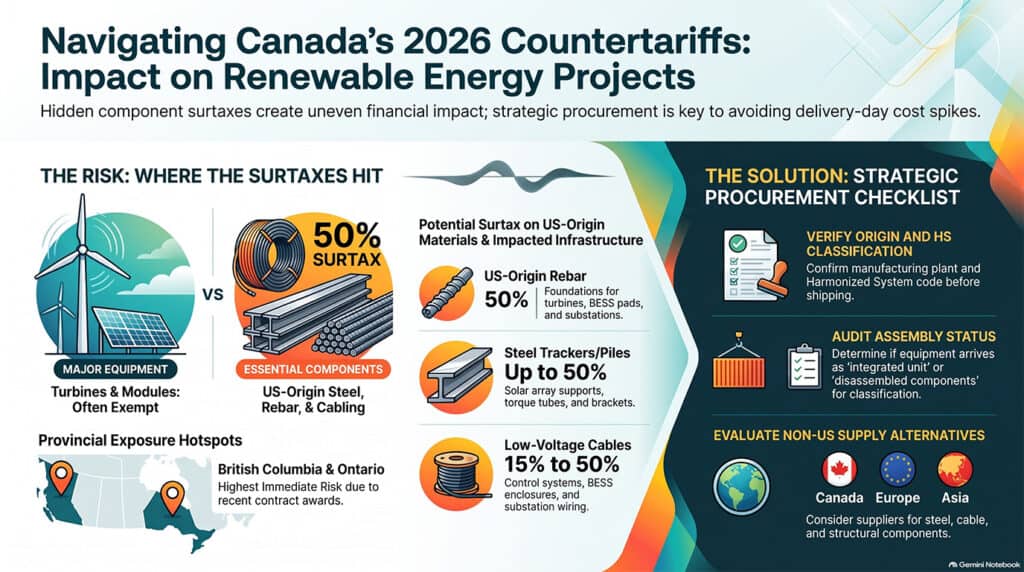
A number of those less visible products are included in Canada’s new measures. The effect will therefore be uneven. Some major equipment packages may see little direct impact. Others, particularly those containing separately imported US steel or aluminum, could face a substantial increase in cost.
What Canada has done
Canada’s latest countermeasures took effect at 12:01 a.m. on September 8, 2026. They apply surtaxes of 15, 25 or 50 percent to designated goods originating in the United States. The federal government introduced them in response to the United States imposing 50 percent tariffs on C$27.6 billion of Canadian goods under Section 338.
These are product-specific measures, not a general tariff on everything purchased from an American company. Whether the surtax applies depends on the customs classification and country of origin of the goods.
That distinction matters because renewable equipment does not always arrive in a straightforward form. A battery system may be imported as an integrated unit or as separate batteries, racks, enclosures, inverters and cooling equipment. A tracker may arrive as a complete machine or as several shipments of piles, torque tubes, rails and fasteners. Those differences can change the customs result.
Where the exposure sits
For battery energy storage, the principal lithium-ion battery classification and conventional power conversion equipment are not directly listed. Separately imported steel enclosures and racks, low-voltage control cable, certain communications equipment and some cooling components may be affected. Any substitution has to preserve the system’s electrical and fire certification, warranty and performance guarantee.
For solar projects, modules and conventional utility-scale inverters are not the principal concern. The tracker beneath them may be. US-origin piles, torque tubes, rails, brackets and fasteners can fall within steel headings carrying a 50 percent surtax. Canadian fabrication is an obvious alternative, provided the materials, coatings, tolerances and quality controls remain consistent with the tracker design.
Substations present much the same issue. The transformer, primary switchgear, circuit breakers and insulators are generally outside the current list. Structural steel, equipment supports, fencing, fasteners, aluminum conductors, copper wire, low-voltage cable and certain communications equipment may not be.
Complete wind-powered generating sets are not directly listed. US-origin towers and separately imported structural components may be affected. It is worth remembering that corporate nationality is not the same as customs origin. A European turbine manufacturer may allocate blades, nacelles or other components from a US factory.
Rebar deserves particular attention
US-origin reinforcing bar is one of the clearest exposures. Ribbed reinforcing bar under HS 7214.20, and relevant hot-rolled material in coils under HS 7213.10, are subject to a 50 percent surtax.
That reaches into turbine foundations, BESS pads, inverter and transformer foundations, substation buildings and other concrete works. Rebar incorporated into an imported precast product may be classified differently from loose rebar, so the treatment should be confirmed rather than assumed.
Canadian and qualifying non-US rebar are not subject to this particular surtax. Even so, a broad shift away from US supply could tighten Canadian mill and fabrication capacity and move prices more generally.
Which provinces have the greatest exposure
British Columbia and Ontario appear to have the greatest immediate project exposure, although the public record does not show whether individual developers have secured their equipment.
BC Hydro has ten electricity purchase agreements from its 2024 call covering nine wind projects and one solar project, expected about 4,830 GWh annually. A further four wind agreements were awarded in May 2026, representing 1,158 MW and about 3,500 GWh annually. These are large, comparatively recent awards involving turbines, towers, substations, roads, concrete and rebar.
Ontario’s IESO executed contracts in 2026 for 13 renewable projects totalling 1,115.1 MW and three new battery facilities totalling 640 MW. Its second LT2 procurement window is already in development. Ontario therefore has near-term exposure across solar, wind, storage and the associated electrical balance of plant.
Quebec has the largest forward procurement exposure. Hydro-Québec’s open wind process seeks 5 to 10 TWh, equivalent to roughly 1,500 to 3,000 MW, and it also has a 300 MW solar procurement. Because these projects are earlier in development, bidders have more opportunity to price the measures properly and specify Canadian or European supply.
Alberta is different. It does not depend on centralized renewable power calls to the same degree. Its exposure sits in merchant projects, corporate power purchase agreements and projects already in development. Where a fixed-price PPA or EPC contract has been signed, an unexpected tariff may be particularly awkward to allocate.
The questions developers should ask now
An awarded power contract does not prove that equipment has been ordered. Some developers may have reserved manufacturing slots before bidding; others may still be negotiating supply and construction contracts. That information is commercially confidential and should not be inferred from a procurement announcement.
Before equipment is released for shipment, project owners should obtain the following:
- the manufacturer and actual manufacturing plant
- the country of origin of each major component
- the proposed HS classification
- separate values for equipment, steel, aluminum, cable and controls
- confirmation of whether the equipment will be imported complete or disassembled
- evidence supporting any in-transit treatment
- confirmation that substitutions preserve certifications and warranties
- the contractual allocation of tariffs and classification risk
A manageable risk if addressed early
There is no need to redesign every project or abandon every American supplier. There is a need to understand what is actually being purchased, where it was produced and how it will enter Canada.
For many projects, the first alternatives to examine will be Canadian tracker steel, rebar, battery enclosures, wind towers, substation structures, fencing and cable. European and Asian equipment can then be evaluated where it satisfies the project’s engineering, certification, financing and service requirements.
Tariffs may be collected at the border, but their cost is largely determined much earlier, when specifications are written, suppliers are selected and contracts are negotiated. Handled early, this is a procurement risk that can be managed. Left until delivery, it can become a project problem.
Official references
- Government of Canada complete countertariff list
- CBSA Customs Notice 26-23
- IESO Long-Term 2 procurement
- BC Hydro 2025 Call for Power participants
- BC Hydro 2024 electricity purchase agreements
- Hydro-Québec electricity procurement
Editorial note
The tariff analysis is a project-screening assessment based on official measures in force or announced as of September 9, 2026. Customs classification and origin are fact-specific. Importers should obtain advice from a Canadian customs broker or request a CBSA advance ruling where the treatment is material or uncertain.